
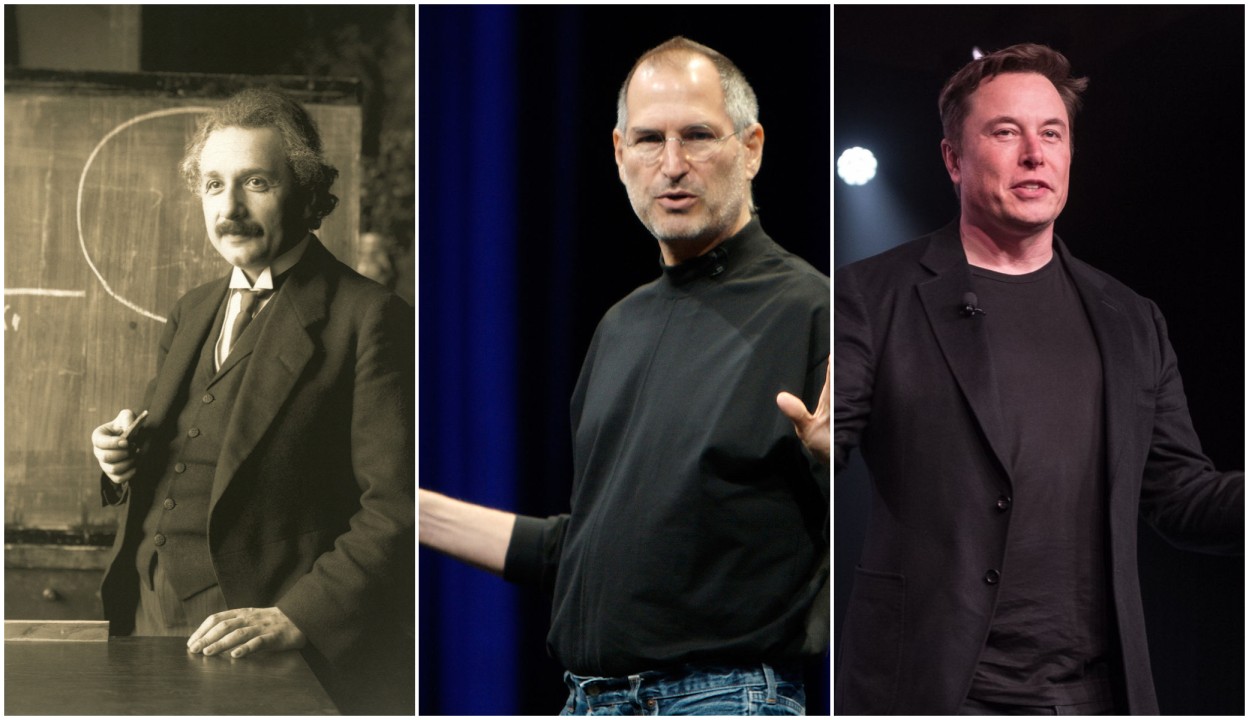
There’s rarely a day when Tesla and SpaceX founder Elon Musk is not seen making the headlines, highlighting his business ventures. A sort of a Willy Wonka figure for technology, Musk seems to mystify people with every announcement he makes about space travel, artificial intelligence and electric cars. The analytical and idealistic engineer who is working to revolutionise transportation both on Earth and in space is clearly not just a businessman and not in it solely for money. And this is what makes him so interesting.
For the same reason Steve Jobs is venerated, Musk has a greater mission and a vast vision for the future and the human race as a whole.
So it’s absolutely not astounding that Musk gets compared to Albert Einstein. He was more than a scientist, he was a philosopher who ruminated on the future as well as the meaning of his work.
These people definitely have quite a lot in common, according to New York University Professor Melissa Schilling. In her business book ‘Quirky’, Schilling explores the lives of breakthrough innovators Einstein, Musk and Jobs, among others, examining their remarkable abilities, personalities and motives.
“These innovators worked in different fields and at different times, yet have some remarkable commonalities. Though they have some traits that we cannot imitate — like Musk’s photographic memory — there are other characteristics we can take advantage of, such as cultivating an ambitious goal, building our self-efficacy and spending time alone to exercise our independent thinking,” Schilling says. “Studying these profoundly important people shows us that there are ways we can nurture the breakthrough innovation potential in us all.”
These creative geniuses are not trapped by prior paradigms, and have three common traits.
- A Sense of Separateness
- Self-efficacy
- An Idealistic Goal